
The New Porn Laws Target the Camera, Not the Bedroom
Nov 05, 2026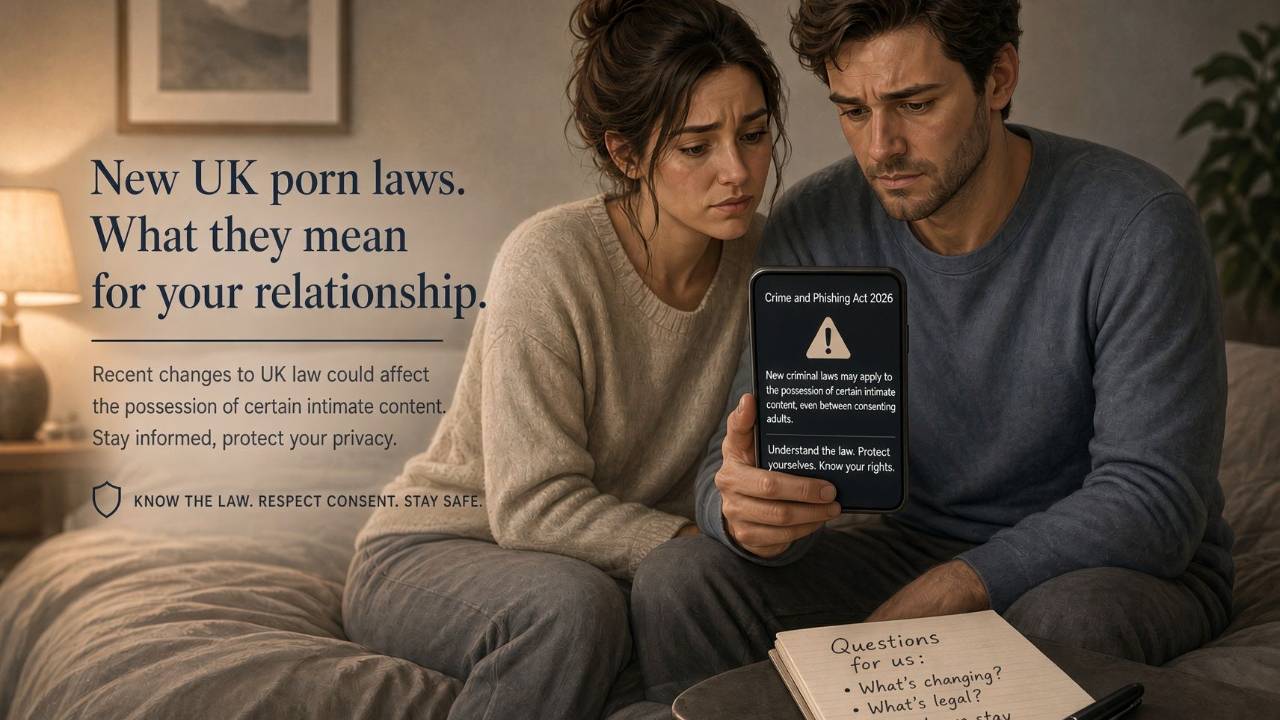
By Dr Massimo Stocchi-Fontana, psychologist, sexologist and mediator
If you have read the headlines about “new porn laws” over the past few weeks, you may have felt a small, private flinch. Perhaps you wondered whether something you and your partner enjoy has just become a crime. Perhaps you thought of a video in a folder you haven’t opened in two years. Or perhaps you felt very little, and then felt oddly guilty about that.
That flinch is worth paying attention to. The law that comes into force on 6 November in England and Wales is narrower than the headlines suggest, while the emotional reaction to it is likely to be far wider. Both matter. One affects what you keep on your phone. The other affects how freely you can talk about desire with the people closest to you, and in my work that second effect is the one I worry about more.
So let me start with the distinction that needs to be clear before anything else, and then look at what sits underneath it.
The law targets the camera, not the bedroom
From 6 November, under the Crime and Policing Act 2026, it becomes a criminal offence in England and Wales to possess or publish pornography that explicitly and realistically shows strangulation or suffocation, penetrative sex between people who are related or pretending to be related, or sexual activity where someone is, or is pretending to be, under 16. It does not apply in Scotland or Northern Ireland. The maximum penalty for possession is two or three years depending on the category, and five years for publishing.
The words to notice are possess and publish. This law is about images. It is not about what two consenting adults choose to do together in private, and nothing in it reaches into your bedroom to tell you which acts are allowed. Non-fatal strangulation without consent was already a crime in its own right. What changes now is that showing it in pornography is too.
Where things become more complicated is the camera. Many couples enjoy filming themselves. Some share that material with each other, some keep it for years, some post it to subscription platforms. If what you have recorded shows breath play or hands on the neck, then keeping it or sharing it may now carry legal risk, even though the act itself took place between the two of you and was entirely consensual.
Why the word “suffocation” matters more than you think
Most people hear this law and think of choking. But the government’s guidance is clear that suffocation does not require pressure on the neck. It can include covering the nose or mouth, or compressing the chest. Whether a particular image falls within the law will ultimately be a question for a court.
This is where we enter murky water. Acts such as face-sitting or smothering, which many people would never have filed under “choking”, are already being removed from some adult platforms for UK users as companies decide to play safe. A broad word, applied cautiously by platforms and anxiously by individuals, tends to cast a much bigger shadow than the law itself intended.
When the law draws a line, we check which side we’re on
Whenever the law draws a line around sex, there is an immediate and very human reaction: people check which side of it they’re standing on. For some, that brings relief, a sense that something they found troubling has finally been named. For others, especially people in kink communities who practise carefully and always with consent, it can bring a wave of shame and a fear of future labels. The question underneath is rarely legal. It is closer to: am I the kind of person this law was written about?
The psychologist Silvan Tomkins described shame as an affect that arrives to interrupt interest and enjoyment. The head drops, the eyes look away, and whatever we were reaching towards suddenly feels exposed. That is a useful way to understand what a law like this can do emotionally. It does not have to apply to you to interrupt you.
In my experience, shame rarely stops behaviour. More often it pushes behaviour out of sight. People talk about it less, check in with each other less, and ask for advice less. That is the shame that keeps people silent, and it creates a new risk of its own. Kink practised well depends on openness: negotiation beforehand, signals during, conversation afterwards. Take away the freedom to talk and you don’t remove the activity. You remove the safety around it.
There is something else I have to say plainly, because it would be dishonest not to. There is no truly safe way to restrict someone’s breathing or the blood flow to their brain. Harm can happen quickly and is not always visible at the time. Anyone who chooses to go there anyway needs a great deal of clear, ongoing communication, and pornography is a very poor teacher. It shows the act and edits out everything that makes it less dangerous: the conversation, the check-in, the moment someone stops.
The quieter casualty is the conversation about desire
Could the new laws affect how comfortable people feel exploring their sexuality? The simple answer is yes, absolutely. Uncertainty makes people over-cautious, and most people will never read the guidance. They will absorb “new porn laws” and “prison” from a headline and then feel unsure where their curiosity is allowed to go.
My bigger concern is what happens to conversations rather than behaviour. Healthy exploration depends on being able to voice curiosity to a partner, a therapist or a group of friends without fear. Fantasy is part of almost everyone’s sexuality. Justin Lehmiller’s large survey of sexual fantasies found that themes of power, control and the taboo are common rather than unusual, and Esther Perel has long argued that the erotic imagination feeds on things we would never actually want in real life. A fantasy is not a plan. If people begin to link fantasy with criminality, more of them will go quiet, and quiet is where shame grows best.
There is a more hopeful side to this. With some education, many younger people in particular could use this moment to ask what is actually expected in sex. A generation that has often learnt about intimacy from what it saw online now has a reason to ask: is this something I want, or something I assumed I was supposed to want? That question can lead to clearer boundaries, firmer limits and a better sense of what someone actually needs from intimacy.
What I hear in the therapy room
I have sat with people who carried a fantasy for a decade without saying it out loud, convinced it meant something dangerous or broken about them. One composite picture comes to mind: a woman in her thirties, in a long and loving relationship, who had never told her partner what excited her because she had decided, somewhere along the way, that wanting it made her suspect. When she finally said it in the room, something shifted. The fantasy did not disappear, but it lost its charge of threat. It became information about her rather than a verdict on her.
I have also sat with people who went along with things they saw on screen because they assumed it was normal, and only later realised they had never been asked. Both of these people are affected by this law. One needs permission to speak. The other needs permission to say no. (The examples here are composites, and this article is written for reflection, not as a substitute for individual clinical support.)
The dilemma: protection or privacy
The dilemma is this. The law exists for real reasons. Campaigners have argued for years that the routine presence of strangulation in mainstream pornography has helped normalise it, particularly for young people who may meet it first on a screen and then encounter it in their own early sexual experiences as something expected. If a law makes that content harder to find, some people will be spared harm they never agreed to.
And yet. Consenting adults who practise carefully may now feel criminalised by association. The loose edges of a word like “suffocation” may push platforms, and individuals, to retreat far beyond what the law requires. Private material made with love and trust may now sit on a phone as a quiet liability. The cost of one approach is visible harm to people who never chose it. The cost of the other is a creeping silence around sex that tends to make everyone less safe. I don’t think either cost is imaginary, and I don’t think one article can make it disappear.
Your desire is not the offence
So hold two things at once. You can take this law seriously, check your devices and delete what needs deleting, and still refuse the shame that tends to travel with it. The law draws a line around certain images. It does not draw a line around your imagination, your curiosity, or your right to talk honestly with your partner about what you want and what you don’t.
Both can be true. Some of what has been normalised in pornography deserves challenge. And the people who explore carefully, with consent and conversation, are not the problem this law is trying to solve.
If you’re worried, here is where to start
Inform yourself properly. Read the government’s own guidance rather than relying on one article, including this one. I am a psychologist, not a lawyer, so if you have a specific legal concern, a solicitor is the right person to ask.
Check your devices. Look at your phone, shared drives, cloud storage and folders you may have forgotten about. Possession counts as ongoing, so anything covered by the law that you still hold after 6 November could be an offence, including old content. There are defences, for example for people who appear in the images themselves, but they come with specific conditions, so don’t rely on them. If in doubt, delete.
Talk with your partner. If this kind of kink is part of your sex life, use this as a reason to revisit what you both want, whether it should continue to be explored, and how you each feel about filming it. That conversation is worth having regardless of the law.
Look after yourself. If you are feeling ashamed or anxious, speak to a qualified therapist who can help you think it through. And remember that feeling worried is not a sign that you have done anything wrong.
The law will change what sits on your phone. Whether it changes what you are able to say to the person you share your bed with is still up to you. What would it take to say it out loud?
If this law has stirred up shame, anxiety or a conversation you don’t know how to start, you can book a session on your own or as a couple. We can talk it through in a space where nothing you say is too much.
Need more help
Sometimes we all need a little extra support, and that's okay. If you're feeling stuck, struggling in a relationship, or you simply want something to change, the most meaningful step is usually the first conversation. One session is enough to get clear on what's actually wrong and what needs to happen next.
Get life strategies
Join our mailing list to receive the latest news and updates.
Don't worry, your information will not be shared.
I hate SPAM. I will never sell your information, for any reason.